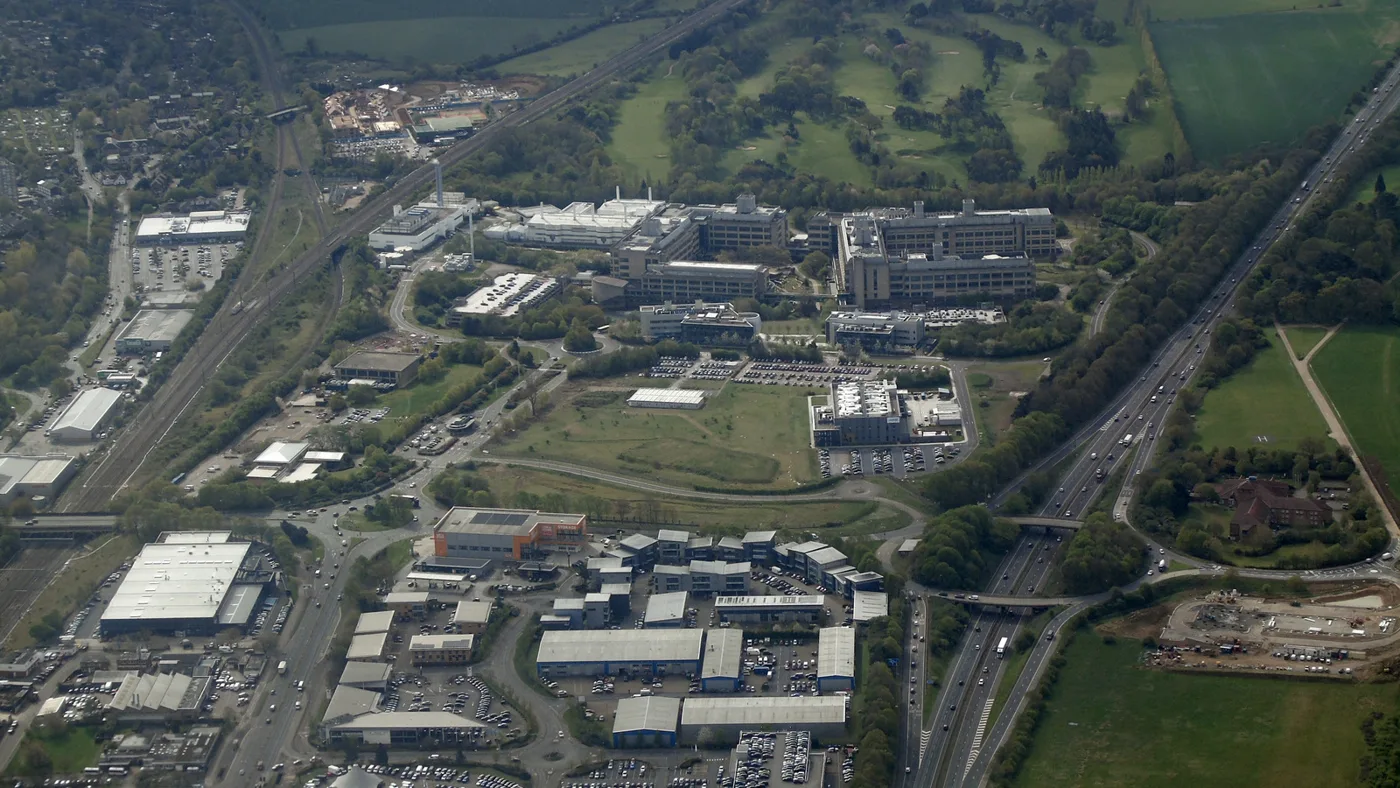

Stevenage's council has costed GSK's departure at £110m a year, £1.1bn over a decade, and put £440,000 behind a taskforce. Its plan is due June 2027.
Stevenage Borough Council has put a number on what losing GSK would cost the town. Its own estimate is about £110 million of economic output a year, and about £1.1 billion over ten years if nothing replaces the activity.
Cabinet agreed the council’s response on Thursday 10 September. It approved up to £440,000 from General Fund balances to set up a taskforce, commission economic evidence and prepare planning work. It also agreed that the risk be added to the council’s Strategic Risk Register. (Cabinet decision, 10 September 2026)
The council issued no news release about any of it. The decision and the 16-page report behind it sit on the council’s democracy site and nowhere else on stevenage.gov.uk.
GSK said on 28 July that it would vacate its Stevenage research site by 2029 and move to a new centre in Cambridge. We covered the announcement itself in our report on the closure. This is what the council has decided to do about it.
What Cabinet agreed
The report is titled “Future of the GSK site: impact, response and options” and was written by Daryl Jedowski, the council’s head of corporate policy and performance. Cabinet resolved to:
- note GSK’s plan to move its research and development operations to Cambridge by 2029, “affecting approximately 1,800 roles in Stevenage”
- grant the strategic director delegated authority to establish a partnership taskforce
- approve up to £440,000 from the General Fund, £350,000 in 2026/27 and £90,000 in 2027/28
- endorse continued lobbying of government over investment, infrastructure and policy
- add the risk to the council’s Strategic Risk Register
- bring an implementation plan back to Cabinet by June 2027
That 1,800 figure matters. When GSK announced the move it gave no job number for Stevenage at all, and the figure was everywhere in the coverage without a first-party source. It is now in the council’s own report and in the published decision.
Where the £110m comes from, and why the report contradicts itself
The headline figure is not a full economic impact assessment, and the report says so in as many words. Table 1 sets out an “initial high-level” calculation:
| Impact | Initial estimate |
|---|---|
| GVA associated directly with GSK’s Stevenage employment | about £70m a year |
| Additional GVA from supply-chain and employee spending | about £40m a year |
| Initial estimated local GVA impact | about £110m a year |
| Indicative impact over ten years if activity is not replaced | about £1.1bn |
GVA, gross value added, is a measure of the value of the output produced in a place. The report warns that the figures “should not be treated as a full economic impact assessment” and will be refined by further analysis.
There is a discrepancy inside the document that nobody has picked up. The opening paragraph of the report says the “direct and locally retained economic impact could be around £80 million in lost Gross Value Added each year, before wider supply-chain and employee-spending effects are included”. The published Cabinet decision repeats the £80 million. But the table that produces the £110 million headline puts the direct figure at £70 million, not £80 million.
Add £80m to the table’s £40m of wider effects and the total is £120m, not £110m. The council has not explained the difference, and neither figure is attributed to a published study.
Where the £440,000 goes
The report breaks the money down, which no coverage of the decision has done:
| Use of funding | Cost |
|---|---|
| A dedicated project lead, salary and associated costs, over two years | £90,000 in 2026/27 and £90,000 in 2027/28 |
| Economic, market and site analysis | £80,000 |
| Additional legal, economic or technical advice | £30,000 |
| Preparation of planning policy evidence, for example a Local Development Order | £150,000 |
| Total | £440,000 |
So the single biggest line is not the taskforce or the economic study. It is £150,000 of planning work. The council is also seeking contributions from private sector partners towards the £440,000, which is money it has not yet got.
Hertfordshire Futures, part of the county council, has already paid for initial advice from the consultancy SQW, which framed the six strands the taskforce will work through.
What the council can actually do, by its own account
The report is unusually blunt about the limits. GSK owns the site. The taskforce “would not make decisions on behalf of participating organisations or have authority over the privately owned site”.
What the council does have is planning. The report lists four levers:
- The Local Plan, which identifies the site for high-value employment uses
- Article 4 Directions, which already remove certain permitted development rights to convert the site to housing without a planning application
- A Local Development Order, which could grant permission in advance for specified kinds of development to speed up a new occupier
- A planning brief or masterplan, plus pre-application agreements, conditions and Section 106 obligations
That is the reason for the £150,000 planning line. The obvious risk to a large employment site in a town with a housing target is that it becomes housing, and the council has already taken the main permitted-development route off the table.
The three places the council is copying
The report names three comparators, chosen for proximity, scale or the kind of transition involved.
- Pfizer at Sandwich, Kent. Pfizer’s 2011 withdrawal put about 2,400 jobs at risk. A government-backed taskforce helped secure Enterprise Zone designation, with “projected business-rate savings of £21.4 million” and a £35 million business investment. The site became Discovery Park, which the report says now has more than 160 companies and 3,500 jobs.
- Vauxhall at Luton. Stellantis announced the closure of the Luton plant in November 2024, directly affecting just under 1,200 employees. Luton Council set up a locally led taskforce with government support.
- MSD at Hoddesdon. MSD agreed in 2016 to sell its process-development and research facility to Pharmaron, completing in 2017, keeping the specialist use and now supporting more than 200 people.
Sandwich is the outcome Stevenage is aiming at. It also took several years.
What is not leaving
The GSK announcement is not the end of life sciences in Stevenage, and the report sets out what stays:
- more than 4,000 people are estimated to work across the Stevenage life sciences campus, which includes Stevenage Bioscience Catalyst, the Cell and Gene Therapy Catapult, LifeArc and Cytiva
- more than 45 therapeutics companies are on the campus, and their leases are separate from GSK’s
- companies based at Stevenage Bioscience Catalyst have raised more than £4 billion since it opened in 2012
- Autolus built its Nucleus manufacturing plant and European headquarters in the town centre, a £65 million investment supporting around 350 to 400 jobs
- the adjoining Elevate Quarter, owned by UBS, holds permission for about 118,500 square metres of life sciences and research space plus two data centres, a revised scheme approved in March 2026 and expected to support around 4,400 to 4,500 jobs
- Airbus Defence and Space and MBDA have been in the town for more than six decades
Stevenage had about 54,000 employee jobs in 2024, roughly 51% of them in science, technology, engineering and related industries. The report says the town’s jobs base has grown by around a quarter since 2015.
The forecast that has just been written off
Before GSK’s announcement, economic modelling projected that the Stevenage life sciences cluster could create around 4,500 additional jobs and raise its annual contribution to the UK economy to £417 million by 2040.
The report’s verdict on that is one sentence: “GSK’s decision changes the assumptions on which those projections were based, updated economic and market analysis will now be needed.”
The timetable, and the line in it that matters most
The report sets out five stages, running from this month to 2029 and beyond.
The line buried in stage two is the one that matters to anyone who works there. Between now and January the council intends to monitor GSK’s employee consultation. That is the first reference in any public document to a formal consultation with the Stevenage workforce. GSK has published nothing about one.
The report also says the council wants to “maintain structured dialogue with GSK on its timetable, workforce and supply-chain support, site intentions, communications and potential legacy contributions”, and that it “has encouraged GSK to consider future legacy commitments such as investment in local skills”.
The council doing this work will not exist when it finishes
Stevenage Borough Council is due to be abolished on 1 April 2028 and folded into a new Central Hertfordshire authority with North Hertfordshire and Welwyn Hatfield. GSK’s move runs to 2029.
The report deals with this directly. Evidence, governance, staffing, commissioned work and funding commitments that extend beyond vesting day “will need to transfer effectively so that delivery is not disrupted”. One of the listed duties of the £90,000-a-year project lead is to “maintain continuity through Local Government Reorganisation”.
That reorganisation is currently paused rather than cancelled, as we reported in our piece on the merger. The report was written on the basis that it goes ahead.
What it means for you
- If you work at the Stevenage site, the council expects a GSK employee consultation and plans to monitor it between now and January. Nothing has been published about its timing or scope.
- If you work in the supply chain, the first strand of the council’s work is meant to identify who is most exposed. That assessment does not exist yet.
- If you want to follow it, the next fixed point is a report to Cabinet by June 2027. The risk will also be reported quarterly to the council’s Audit Committee through the Strategic Risk Register, which is a faster and more public route to the detail.
- If you are worried about housing on the site, the Local Plan identifies it for high-value employment and an Article 4 Direction already removes certain rights to convert it without planning permission. Any change would go through the planning process, which you can follow on our Stevenage planning page.
- Nothing has closed yet. GSK’s move is phased to 2029 and no redundancies have been announced.
Sources
- Stevenage Borough Council, Cabinet decision and minutes, item 10, 10 September 2026
- Stevenage Borough Council, Future of the GSK site: impact, response and options, report to Cabinet, 10 September 2026
- Stevenage Borough Council, Cabinet agenda and papers, 10 September 2026
- GSK, GSK to establish new flagship R&D centre on Cambridge Biomedical Campus, 28 July 2026
Have your say